Sunday, July 5, 2009

Mother Nature Gives Us a Chance

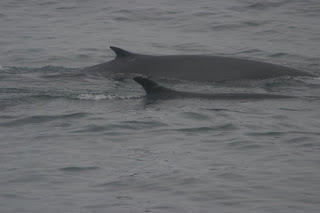
July 3rd, on the 8:30 trip, senior naturalist Zack Klyver reported that after the fog clearned out a bit the whale watch was lucky enough to find two finback whales and a minke whale. Many harbor and grey seals, between 100-200 were also seen throughout the trip! The photographs of these two finback whales were taken through the North Atlantic Finback Whale Catalog database and both finbacks were identified! One was a whale named Bolshoi and the other as FWC #0370! All finbacks in the catalog have a number, but some also have special names. FWC #0370

Bolshoi is a whale we saw on our trip the day before. It seems this whale decided to stick around and take advantage of the large amounts of food located the Ball Park feeding grounds. On this trip the captain observed on the fish approximately 50-150 feet below the surface on the depth sounder.
Bolshoi

Our research assistant, Lauren, noticed an entanglement scar on Bolshoi's tail stock. Due to the large amounts of lobster and gillnet fishing gear in the Gulf of Maine, whales occasionally become entangled in the line, that can become wrapped around the tail stock and chaffe into the skin, then leaving a scar. These scars are very important to photograph. Not only do they allow us to identify the whale, but also monitor its health prior to an entanglement.


Many species of seabirds were observed including, red-necked phaloropes, fulmars, northern gannets, shearwaters, Wilson storm petrel, and two North Atlantic puffins which flew around the boat!


On the afternoon trip, a group of 4 finbacks surfaced very close to the boat! Allied Whale's research vessel the Borealis, emerged from the fog. Researchers from Allied Whale were out offshore deploying pop-up buoys. This research equipment is used to record the sounds whales makes below the surface. The buoys remain submerged in hundreds of feet of water for 3 months collecting the sounds of large baleen whales like humpback, finback, and right whales. Two other finbacks were located as well, with a total of 6 finback whales seen on this trip. Still many seals and birds around as well.

Wednesday, July 1, 2009

A Whale of a Day in the Fog!

We had a wonderful afternoon trip today! The fog finally gave us a little break and we had about a mile of visibility allowing us to see a great deal of wildlife offshore. As we headed out of Frenchman Bay, past Egg Rock, two juvenile bald eagles flew by the boat! We continued to see a great deal of birds including Arctic terns, Wilson storm petrels, Greater, Manx, and Sooty shearwaters, Northern gannets, as well as a couple of North Atlantic puffins!

We were thrilled to see the fog clearing and started looking for blows! Harbor and grey seals started appearing everywhere. Harbor porpoise came up all around the boat. The water was so calm with only a slight swell. Finally, one of our crew members spotted a blow in the distance! It was a finback whale! Myself and the crew were so thrilled and passengers cheered in excitement! Below is a picture of the whale's "footprint" or fluke print. This smooth patch of water at the surface is created by the up and down movements of the whale's large fluke or tail.

As the whale surfaced, Laura Kennedy, our bird researcher, spotted the large dorsal fin of a Basking Shark! It came right up next to the boat. This species is the second largest on the planet. They can reach lengths of 35 feet and weigh up to 8,000 pounds! But this shark eats some of the tiniest creatures in the ocean-plankton! They capture their prey on bristle-like structure called gill rakers. They will filter about 2,000 tons of water per hour!

Soon after spotting the first whale and basking shark another finback whale surfaced nearby. We decided to check out this whale since the other finback was taking 12-14 minute dives. This whale spent a great deal of time at the surface allowing us to get some great looks! The water was like glass and we could see the whale's entire body as it came to the surface. It was awesome!It was hard to keep track of the numerous seabirds, seals, and porpoises.


These photos were taken by one of our research assistants, Lauren Donnelly-Crocker. One of the finbacks(the photo above) seen on this trip was later identified as Bolshoi.

Saturday, June 27, 2009

Finback whales in the fog


Well we decided to take a chance and face the fog today. We could not visit Petit Manan to see the puffins because of the visibility, so we went right out to the Ball Park in search of whales. As we approached our destination Captain Larry started seeing tons of bait fish on the fish finder. He slowed the boat down and as we drifted through the Ball Park we kept our ears open hoping to hear the blow of a whale.

The foggy weather also gave fellow naturalist and UMaine graduate student, Kaitlyn Allen, the chance to test out her hydrophones. This piece of equipment is used to record whale sounds in the water. Kaitlyn is recording whale sounds and comparing them to the whales' activity seen at the surface. Different whale species make specific sounds and so we can identify them without even seeing them! Some whales, like the finback, can be heard from up to 1,000 miles away! Sound travels much farther distances in water than it does in air. We think the sounds they produce help them in finding food and are used for communication with other whales, especially when looking for potencial mates during the breeding season.

Many pelagic birds such as Northern Fulmars, Greater Shearwaters, and Wilson Storm petrels were seen throughout our search. Bird researcher, Laura Kennedy, was aboard collecting data for her graduate studies. Many grey and harbor seals popped up near the boat as well with one large grey seal coming up along the side of the boat!


Suddenly as more seals and birds began to appear....."whoosh" the breath of whale off in the distance. We heard the blow a few more times and as the boat slowly approached two large finbacks appeared at the surface! We got good looks, but soon lost them in the thick fog. But we considered ourselves lucky to have found anything!

Unfortunately, we were not so lucky on our second trip. We heard a few blows, but could not locate the whale(s). Oh well. But still tons of seals, birds, and bait! If the fog would have lifted there would have been a good chance of finding a whale. But Kaitlin informed us that she may have picked up something interesting on her hydrophones! Maybe one of the whales we saw on the morning trip still hanging around?

So, despite the fog, a great deal of important and fascinating research was conducted on the whale watch today. Hopefully this foggy weather will soon disappear and we can enjoy looking at whales along with listening for them above and below the surface.

Friday, June 26, 2009

The Fog Will Not Hold Us Back!

It has nearly been a week since we have been on the water due to the rain, fog, and rough sea conditions offshore. Last week, we had great weather and whales, but mother nature has not been cooperating lately. Today, despite the patchy fog in Bar Harbor, conditions seemed promising offshore so we decided to take the chance and venture out into the Gulf of Maine!

While venturing through the "Ball Park", an area where whales are typically found due to large concentrations of food, the fog crept back in, making it slightly more challenging to find the whales. When searching in fog we use our ears and listen closely for the audible blow or exhalation of a whale. During the whale search we did see many seals at the surface as well as numerous pelagic seabirds such as, Wilson Storm Petrels and Greater Shearwaters. Captain Jerry noticed a great deal of bait on the fish finder. So there seems to be a lot of activity going on in the Ball Park, but the whales were elsewhere.

Heading southwest, Captain Jerry stopped at Mount Desert Rock, a small remote island 25 nautical miles from Bar Harbor. This island is home to the Edward McC. Blair Marine Research Station, where Allied Whale conducts marine mammal and seabird studies during the summer months. This island is home to approximately 800-900 harbor and grey seals. A working historic lighthouse, built in 1847, is also on the island.

The search continued as the boat headed home, but no whales were spotted. We usually have a high sightings rate, but with the fog and whale distributions being a little wide spread at this time of year, we sometimes have difficulty finding them. But this is mother nature we are working with and summer has just arrived! Hopefully the weather will improve and we will be back out on the water again tomorrow!

Tuesday, June 16, 2009

Some close up looks at a finback whale

Here are some great photos from our research intern, Laura, of a finback whale seen on the whale watch on Monday, June 15th. When photographing finback whales, Allied Whale researchers take a series of photos along both sides of this massive mammal capturing the natural features we use to identify them. The swirly, grayish-brown pattern along the side of the whale is called the chevron. Like a fingerprint, each one is unique to each individual whale. The dorsal fin, located two-thirds down the whale's back, is also photographed. Like the chevron, the dorsal is different. Some have nicks and other distinctive markings.


Sunday, June 14, 2009

Finback Whales GALORE!


Despite the rainy weather we had a wonderful day on the water. As we headed offshore we soon spotted a blow in the distance. As we approached we discovered that not only was there one whale, but two! It was a mother and calf pair of finback whales-the first pair of the season! We were fortunate to get wonderful looks as both mother and calf surfaced together, close to the boat, making everyone gasp in amazement!


After numerous close looks we decided to move on to the south, curious to see if we could find more whales. And we DID! A couple of blows turned into three, then four, five, and finally six! No doubt our new Allied Whale research intern, Lauren, was busy collecting data! There were six finback whales feeding in this one specific area! The boat's fish finder indicated a great deal of bait fish, most likely herring, a couple of hundred feet down. These finback whales most likely focusing on feeding. It is amazing to think that these whales can consume between 4,000-6,000 pounds of fish a day! I guess they must considering they weigh 60 to 70 tons!

Along with the 10-12 whales we saw today we also had great pelagic seabirds including: North Atlantic puffins, Greater shearwaters, Northern gannets, and Wilson storm petrels. Lots of harbor and grey seals out there too! So all in all another great day off shore in the Gulf of Maine!